
"When the Wind Blows..
in Sanctuary, Out of the Blue"
The Farm Margaret River 2026, Australia
「風が吹くとき、思いがけず」 The Farm Margaret River 2026 (オーストラリア)

During this residency, I presented two installations that combined Australian plants with a uniquely Japanese way of thinking.
In Japan, there is a belief called Yaoyorozu-no-Kami (eight million gods), which means that gods reside in everything in the universe. This applies not only to physical objects, but also to invisible phenomena, the human heart, and the spirit.
One of the two works involves the creation of a sacred space inspired by a traditional Japanese certain Noren, and the other is a work "textiles created by the wind."
What these two works have in common is the presence of wind. How does this wind connect to a uniquely Japanese concept?
In Japanese, there are various names for wind depending on the season. For example, the first strong wind that always blows in spring is called Haru Ichiban, and the wind of autumn is called Kogarashi. Also, in Japan, there are glass bells called Furin, which are hung from the eaves of houses in summer, and people enjoy the pleasant sound they make with each breeze and Uchiwa (hand fans) used to beat the heat. There are many other seasonal traditions and pastimes unique to Japan that involve interacting with the wind, such as Koinobori (carp-shaped streamers) and Kamifusen (paper balloons). Because of these things, I think that the Japanese have a unique sense of wind, and that is why I decided to create 'textiles' using wind.
今回はオーストラリアの自然、滞在先であるマーガレットリバー固有の植物と、日本ならではの思想 (自然観) を融合した作品を制作した。
日本には「八百万(やおよろず)の神」という宇宙のあらゆるものに神が宿っているという考えがあるが、これには物理的な物だけではなく、目に見えない現象や人間の心、精神なども含まれる。
この滞在では2つのインスタレーションを発表した。1つは日本ののれんからイメージした"聖域"、もう1つは"風によるテキスタイル"である。
2つの作品に共通しているのは、風の存在である。この風が日本人の考え方とどのように結びついているのかといえば、まず日本語には、季節ごとに様々な風の呼び方があり、例えば、春に吹く1番最初の強風を春一番、秋の風は木枯らしと呼ぶ。また夏には風鈴が奏でる心地よい音色を楽しみ、うちわで暑さをしのぐ。他にも鯉のぼりや紙風船など、風と戯れ、楽しむような日本ならではの季節の行事や遊びが数多くある。
こうしたことから、私は日本人が風に対して独自の感覚を持っていると考え、今回の制作では風から着想を得た'テキスタイル'を制作した。

The Farm Margaret River 2026 Artist in Residence (Australia)


The Farm Margaret River 2026 Artist in Residence (Australia)
"WHEN THE WIND BLOWS"
The Farm Margaret River 2026
Artist in Residence, Australia
The Farm Margaret River 2026
アーティスト・イン・レジデンス (オーストラリア)
In Japan, when visiting a shrine, there is a custom of ringing a rope with a bell attached to let the gods know of your visit. This is called a Suzu-no-o (bell rope), and when I saw the familiar honkey nuts from the Marri tree, in Australia, I felt that their shape resembled those bells. So, I strung the nuts together like beads and installed them between two trees, using a traditional Japanese curtain Noren as a motif. When the "Noren" sways, we feel the 'will' of the wind.
The other work is "Textile created by the wind."
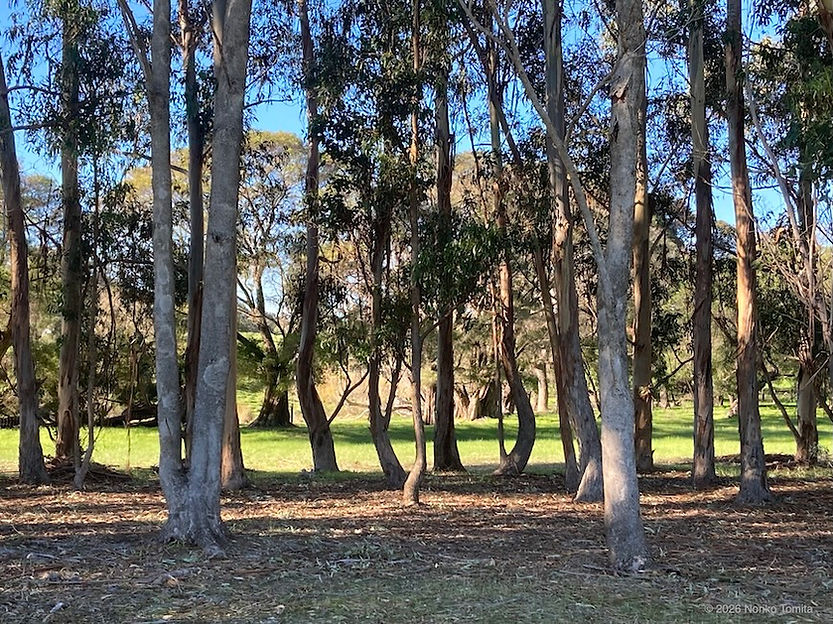
When I was strolling through a nearby forest, I found a place where trees grew in clusters, like the warp and weft threads of a woven fabric. There were lots of fallen leaves on the ground, occasionally blown up by the wind, and that's when I came up with this 'textile'.
First, I collected beautifully colored fallen leaves, painted only one side of each leaf blue, and laid them out like a carpet on the ground between the trees, blue side up. Then, each time the wind blew, the leaves flipped over, revealing the original leaf color on the unpainted side, creating a 'textile' with a mix of blue and other colors. The reason I chose blue for the coloring is because it's the color of the sky. The land here is a mix of green grass and brown soil, with the white and black of charred wood, and the reds and yellows of flowers, but there's no blue. That's why I wanted to bring the sky to the ground.
Then, when the blue-painted leaves turned over, I thought they would blend in with the original fallen leaves, making them indistinguishable from the blue-backed leaves. But surprisingly, the leaves are more distinguishable than I thought. The changes in color, shape, and surface patterns due to decay are unique; it's only when they are mature fallen leaves that they acquire their own unique color and shape.
1つめの作品は、日本ののれんをモチーフに制作した聖域である。
日本では神社参拝時に自分が訪れたことを神様に知らせるため、鈴の緒を鳴らす習わしがある。オーストラリアで通称ホーキーナッツと呼ばれる木の実を見た時、その形状が神社の鈴に似ていると感じた。そこで玉のれんをイメージして、ナッツをビーズのように繋ぎ、2本の木の間に設置した。その"のれん"が揺れる時、風と共に'意思の訪れ'を感じるというものだ。
2つめの作品、"風が生み出すテキスタイル"については、近所の森を散策した時、織物の経糸と緯糸のように木が格子状に群生している場所に遭遇した。そして地面の落ち葉が風に吹かれ、時折舞い上がるのを見て、この作品を思いついた。まず、美しい色味の落ち葉を集め、その葉の片面だけに青色を塗り、木々の地面に青い面を上に絨毯のように敷きつめる。そして風が吹き、葉がひっくり返ると、オセロのように色を塗っていない面の美しい葉の色が現れ、それらがムラ染めのように青と混色することで、風による'テキスタイル'となる。またこの青は、青空の色であるが、この土地は草の緑と土の茶色が主で、他には家屋や炭化した木の白や黒、あとは花の赤、黄色などが見られるが、青はない。私は空を地上に持ってこようと思った。
実のところ、青色に塗った葉が裏返ると、着色していない落ち葉との区別がつかなくなると思っていたが、思ったよりも葉の見分けがつくことが大きな発見であった。紅葉して落ち葉となり、虫喰いや腐食によって、色、形状、表面の模様が変化し1枚1枚に個性がうまれる。葉は朽ちていく段階になって自分だけの姿形を得る。